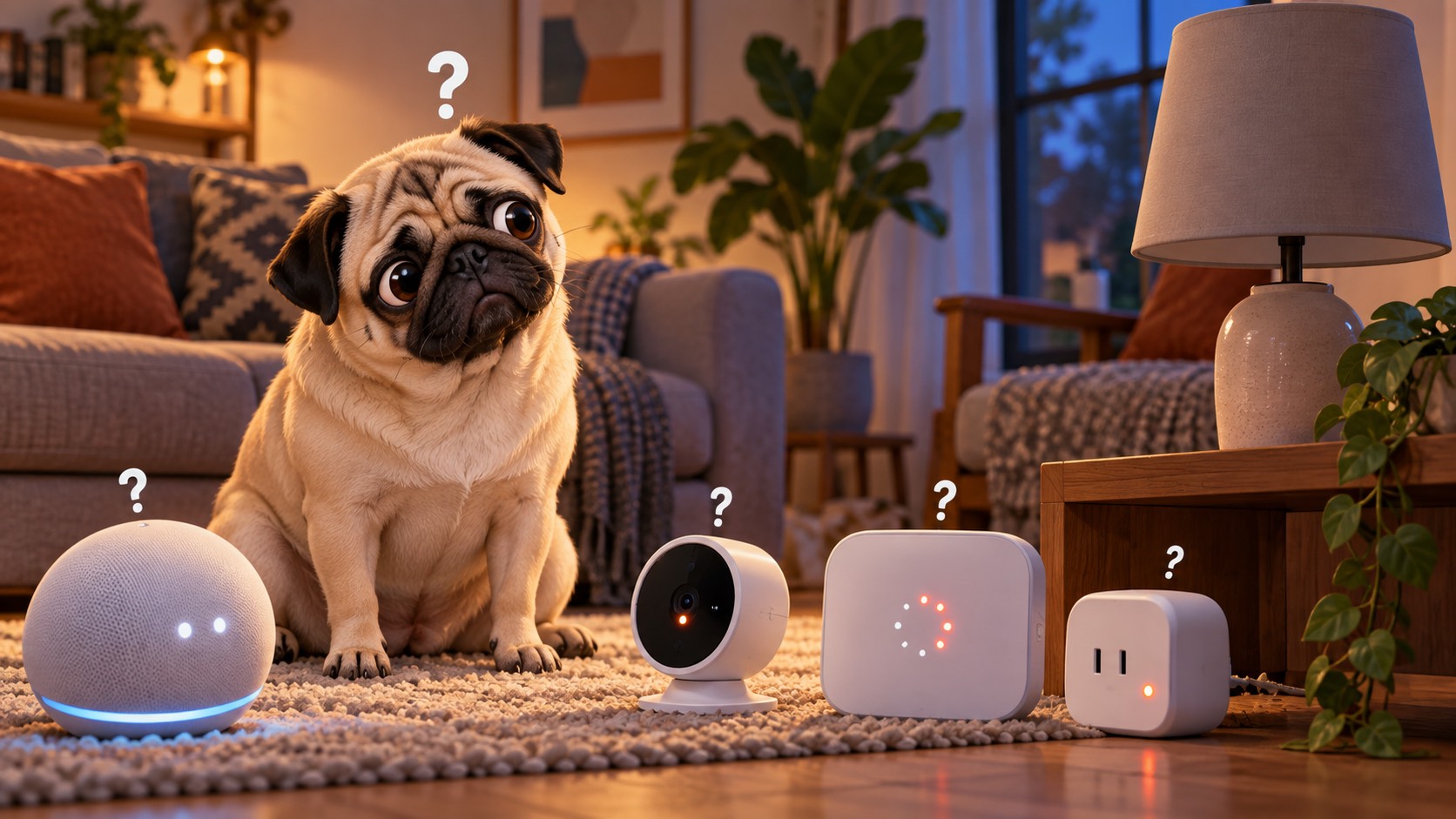

Humans love calling things smart. Smart lights. Smart speakers. Smart thermostats. Smart doorbells. Soon there may be a smart spoon that tells you that you are eating soup. But I have a question from the floor level: what exactly makes a device smart?
I propose the Pug Test. It is simple. A device is smart only if it makes an ordinary moment easier without requiring a password, an update, a second app, and a forty-minute argument near the Wi-Fi router. If you ask a light to turn on and it turns on, excellent. If it says it cannot connect to the cloud while you are standing in the dark, that light has failed the Pug Test.
Smart-home devices should understand normal requests. “Make the room cooler.” “Turn off the kitchen.” “Tell me if someone is at the door.” They should not respond with a blinking light that means something only the instruction manual understands. A pug cannot read a blinking code. Most humans do not want to read one either.
The best technology quietly helps. It keeps a house comfortable, makes a routine smoother, and does not demand applause. It should still work when the internet is having a bad day. It should be easy for visitors to use. And nobody should need three accounts to dim a lamp. A lamp had one job before it became smart. Let us not make it difficult.
So before buying the next clever gadget, ask the Pug Test question: will this help me on a tired Tuesday night? If the answer is yes, welcome home. If the answer is “probably, after setup,” maybe leave it at the store. I am not against smart devices. I simply believe the smartest home is one where the humans can still find the light switch.
There is a practical lesson under the joke. Small everyday frustrations deserve simple fixes because people spend real time dealing with them. A better version does not need to be fancy. It just needs to be clear, fair, and useful when someone is tired or in a hurry. That is my official Pug DJ standard: fewer hoops, fewer mysteries, and more time for the parts of the day that actually matter. It is also a good test for any new idea: would this make a normal day easier for someone who is busy, hungry, carrying too many bags, or simply ready to go home? If the answer is no, it may be clever, but it is not helping. That is a useful difference for every company, app, store, and human to remember.
One last practical thought: good ideas should make ordinary days easier, not ask people to work harder for the same result. That is a standard worth keeping.