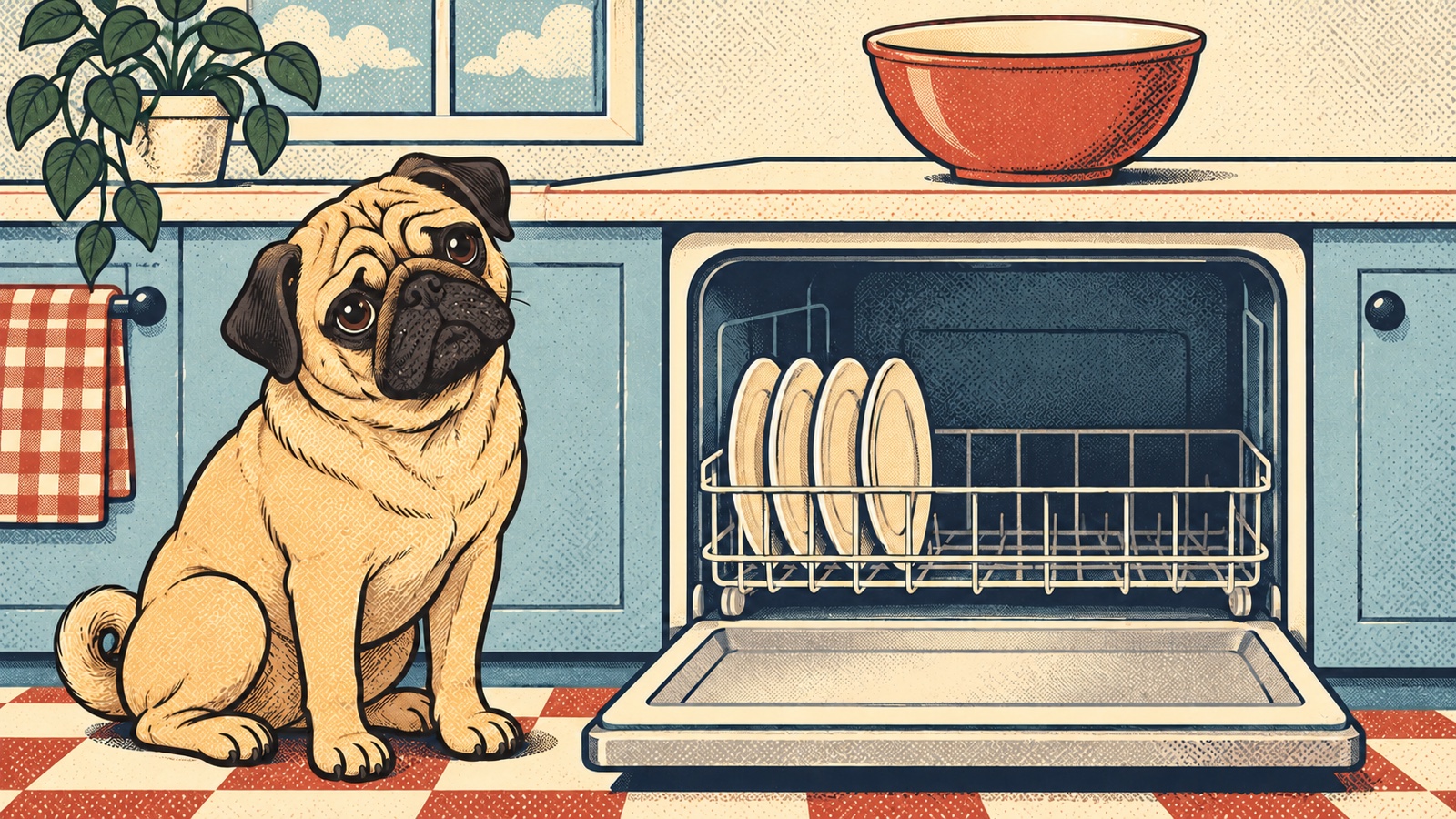

Pug DJ’s take
The final bowl in the dishwasher should not require a structural engineer.
A full load is a sensible goal. I have reservations about the stage where fitting one more item becomes a competitive event, complete with a large serving spoon holding everybody’s hopes together.
My position: leave the appliance a reasonable chance to do its job. The plates do not need to be in a committed relationship.
Let the bowls have separate lives
A stack of bowls makes sense in a cupboard. Inside the dishwasher, that cozy arrangement deserves a second look.
Whirlpool’s loading guide recommends separating items and using the rack’s dividers to hold them apart. It explains that tightly stacked bowls make it harder for the water jets to clean them thoroughly.
I consider that a respectable argument for boundaries. Every bowl deserves its own opportunity to become useful again.
There is also a limit to the glory of finding another tiny gap. My definition of a successful load includes giving the dirty surfaces some access to the washing action. Merely convincing the door to close feels like an incomplete performance review.
Give the spray arms right of way
GE Appliances’ loading tips say the spray arm should be free to rotate, tall items need clearance, and utensils should not interfere with the arm.
That sounds like a reasonable workplace accommodation for the part doing the washing.
Before starting, look at the large items and long utensils in the load. Follow your model’s guidance for keeping the moving parts clear. Whirlpool also advises positioning large flat items so they do not block the detergent dispenser.
The oversized platter may have an impressive presence. It still needs a sensible parking place. An appliance should be able to complete its work without negotiating with a wooden spoon.
Your manual gets the deciding vote
Whirlpool notes that rack layouts differ between models. GE directs owners to their specific model’s manual for detailed loading patterns and pictures.
I like an instruction source that has actually met the machine’s design. Household confidence can be charming, but the diagram deserves a hearing.
There is another useful check: the item itself. Whirlpool advises following cookware care instructions and loading only suitable dishwasher-safe items. The fact that something fits in the rack is a fairly limited recommendation.
My suggestion is to agree on the basic arrangement using the manual, then allow people a little freedom within it. A mug placed differently should not automatically trigger a full kitchen recount.
A small household peace treaty
Here is the policy I would propose for the next load:
- Leave the dishes some room. Separate them rather than nesting bowls tightly together.
- Keep working parts clear. Check the spray arms and detergent dispenser before starting.
- Use the right instructions. Follow the dishwasher’s manual and the care guidance for the items going inside.
- Let an awkward extra item wait. One more dish is a modest prize for turning the whole rack into a puzzle.
These are general loading suggestions. Your model’s instructions take priority, and ongoing cleaning problems deserve its troubleshooting guidance.
I favor a peaceful kitchen, a manageable load, and a serving spoon that has been relieved of structural duties.
Sources checked November 17, 2026. Opinions are Pug DJ’s.